Friday, April 30, 2010

Bako: Where Nature Is Right In Your Face

Bako is Sarawak's oldest national park, and is located at the tip of the Muara Tebas peninsula. The park was gazetted as a nature reserve in 1957, and is arguably the best place to experience wildlife. Accommodations are very basic and can be very uncomfortable due to the high humidity. However, we had the best wildlife experience right at our door steps. The chalet block that we were housed is built on swampy land with puddles of stagnant water. As you may have guessed, the area is also a heaven for mosquitoes but the wildlife around us was amazing.
We had two Wagler’s Pit Vipers as neighbors and no one battered an eye at the presences of the park’s only venomous snake. The two snakes were left unmolested (no anyone attempt to lop their heads off and mince them up). I spent two days photographing the male as he was in a better position. The juvenile female was a tad small and in a harder location.
Imagine my shock coming face to face for the first time with the largest wild pig I have ever seen. The female Bornean Bearded Pig and her young ones emerged from the bush in the evening for a drink of water. I spent the next day and a half looking out for the pigs but I never got my shot at the large female. Instead, a large male came out to drink while we were waiting for the White-bellied Woodpecker and I got my bearded pig portrait.
Just like Periyar, the Silvered Langurs came right up to where the forestry office and spent a good part of the morning foraging in the trees.
Flying Lemur
A mother and baby were also sighted near the chalet and as usual the mother flying lemur slowly maneuvered around the tree to the attention got too much.
The experience that we had, left me wanting more. I can't wait to head back again. Should you want encounters of the close kind, Bako is a great place to experience wildlife at their best.

Wednesday, April 28, 2010

Three nights of ‘Frogging’ Fun

Besides looking for wildlife in the day, we went out at night with our guides to look for things that go hop, hop, hop in the night. We came away with a haul of frog photos over three nights. The experience left me wanting more ‘frogging’ fun.
Though there are many amphibian species, more than Singapore, it does not mean the rain forest eco-system in Borneo is not under threat. It is and we need to do more to save these amazing creatures and many other animals from extinction.
Filed-eared Tree Frog aka Borneo Eared Tree Frog. These tree frogs are found in lowland rainforest up to elevations of 400 metres. They are most commonly found suitable breeding ponds, clinging to nearby vegetation a few metres from the ground.
The Wallace's flying frog got its name from the 19th-century British naturalist Alfred Russel Wallace, who first described the species in 1869. Also known as parachute frogs, Wallace's flying frogs inhabit the dense tropical jungles of Malaysia and Borneo.
To see more of these amazing creatures head on over to my Flickr site.

Monday, April 26, 2010

The Great Apes of Semenggoh and Matang

Semenggoh Wildlife Rehabilitation Center and Matang Wildlife Center rehabilitate confiscated orangutans that have been in prolonged human captivity. Once nursed back to health, they are released into the protected forest reserves to live semi-wild, where they forage naturally for food. These Orangutans will often not appear, as long as they have food in the forest. They will remain unseen unless you to see one whilst on a trek. Chances of seeing them are higher when food is scarce.
During our visit, we had the pleasure of seeing Richie at Semenggoh Wildlife Rehabilitation Center, and Aman and George at the Matang Wildlife Center.
The alpha male of Semenggoh, Richie is over 30 years old. He has been rehabilitated into the wild but returns to visit from time to time.
Aman (23) was rescued from a market in Sarawak in 1989, had been kept at the Semenggoh Wildlife Rehabilitation Center. During this time, he suffered two serious accidents. He bit through an electric cable and had to have his tongue removed. He also developed blinding cataracts in both eyes as a result, which left him blind for almost 10 years. Aman also lost his left index finger, which it was bitten off by another orangutan.
He was moved subsequently moved to the Matang Wildlife Centre at the end of 2000. In 2007, Aman became the first orangutan to successfully undergo cataract removal operation on both his eyes.
George (28) like Aman was from Semenggoh. He was moved to Matang after Richie made it clear that George was no longer welcome there, they had had a massive fight.

Saturday, April 24, 2010

The Not So Common Paradise Flycatcher

The Common Paradise Flycatcher or the Asian Paradise Flycatcher dwells in thick forests and well-wooded habitats and is a winter visitor to Singapore. During the migratory season, a number of birders here were searching for the elusive adult male Asian Paradise Flycatcher (not so common paradise flycatcher). I have seen the females during this year’s season but the adult male proved to be impossible to locate.
My next encounter with the Asian Paradise Flycatcher was at Periyar Tiger Reserve, Thekkady, India. Where I finally caught a glimpse of the adult male but sadly I didn’t have time to sit and wait for the bird. It was the most beautiful bird I’ve seen.
Imagine my excitement when our guide in Sarawak briefed us on the birds to expect and this species was included. There is a resident population of Asian Paradise Flycatchers in Kubah National Park.
Next came, the dilemma of which bird to follow and which to give up for the next trip. Hard choices but one has only so little time. I finally caught the adult male Asian Paradise Flycatcher in pixels.

Thursday, April 22, 2010

The Pristine National Parks in the Land of the Hornbills

Just got back after spending 5 ½ incredible days in Sarawak observing nature. During this period, we stayed in two national parks and visited three others before ending our trip at an ultra swank nature friendly five star resort that only serves organic vegetarian meals.
Our first stop was Kubah National Park, which is about 20 km from Kuching. Kubah was gazetted as a national park in 1989, and was only opened to the public in 1995. The park consists largely of undisturbed forest, and is home to a variety of wildlife, including bearded pigs, black hornbills, mouse deer, squirrels and numerous species of amphibians and reptiles.
At the western corner of Kubah is the Matang Wildlife Centre, which houses endangered wildlife. The center houses Orang Utans and other wildlife, and is used as a research center. Matang serves as a holding centre for confiscated and surrendered animals in Sarawak. Where possible, the animals are rehabilitated and released into the wild or semi-wild conditions as part of conservation efforts for threatened wildlife.
From Kubah, we made our way to Bako National Park, Sarawak's oldest national park, covering an area of 2727 hectares at the tip of the Muara Tebas Peninsula. The park has been a protected area since 1957, and is probably the best place in Sarawak for wildlife experience.
The park is home to a number of species that are highly endangered such as Proboscis Monkey, Silvered Leaf Monkey or Silvered Langur, and the Bornean Bearded Pig. Bako is also home to a number of snakes, most of which are harmless. The park is also a great place to bird watch as there are over 150 species here. Bako never sleeps in the night, nocturnal creatures such as the Colugo (Flying Lemur), Pangolin, Mouse Deer, various bats, Tarsier, Slow Loris and Palm Civet are about.
On the way to Borneo Highlands Resort, we dropped in at Semengoh Orang Utan Sanctuary located in Semengoh Forest Reserve, Sarawak's oldest forest reserve to view rehabilitated Orang Utans that have been released into Semengoh. We were fortunate enough to have the dominant male of Semongoh drop in at the 3 pm feeding. Then we headed to our final destination for some pampering in the form of luxurious accommodations and organic vegetarian food before our flight home to Singapore the next day.
Happy Earth Day! Do your part in conservation.

Sunday, April 18, 2010

Mother Nature’s Avian Architects/Builders

The Baya Weavers are only found in open grasslands and they are not often seen by Singaporeans. I remembered annual trips to Chao Chu Kang during Qingming Festival or Tomb Sweeping Day as a kid and seeing Baya Weavers nest hanging off trees in the refuse dump area near the Buddhist cemetery where my grandmother was laid to rest. Over the years the birds disappeared as the dumping activity got even busier as Singapore pursued economic progressed. Then the graves got exhumed and we never went back to that area since.
Recently, a flock of Baya Weavers were spotted nesting and I had to go back to see these birds from my childhood. Baya Weavers like Munias eat mainly grass seeds. These birds are usually dull looking but come breeding season, the males take on brighter colors in their breeding plumage. Breeding males have a bright yellow crown, dark brown mask, blackish brown bill; upper parts are dark brown streaked with yellow, with a yellow breast and cream buff below. They also become Nature’s gifted architects and builders as they start to build their amazing nests.
The Baya Weaver's nest hangs from a branch and looks like a tear drop with a funnel below. These nests are made entirely out of strips of grass which the birds collect by cutting a notch in a tall grass, and will last the birds through their breeding season.
The main contributing factor to the scarcity of these birds here is habitat loss. Baya Weavers depend on tall grasses such as Guinea Grass for both their food and for their nesting material. In addition, people harvest these nests for commercial purpose; they are sold as decorative items to adorn home gardens.

Thursday, April 15, 2010

Altercation with Self

While packing up my camera equipment in the car park of the Mandai Orchid Garden. I heard the sounds of an angry bird in the background. On turning around to look, I spotted a sunbird having an altercation with its own image in a van’s side view mirror.
You may have seen similar incidences in other car parks or with cars parked close to a tree lined area. The need to defend territory against other rival males is common to males of all species. In this instance, the male Plain Throated Sunbird mistook its own image as another handsome male coming to lure his mate away.
Hence, he launched a fearless attack to defend what is his. So engrossed was he, in his fight that he did not even notice me pointing a huge lens at him.
The altercation with his mirror image went on for a good 15 minutes before he noticed my presence. That did not seem to faze him; he flew over to the other side view mirror and began his fight again.
Round 2 was a shorter fight as I guess he became tired and had to sit on the mirror to rest.
This chanced encounter gave me a chance to capture a series of comical photos. It also presented an opportunity to show you the aggressive side of a sunbird. The only casualty  of this altercation with self was the side view mirror, it was covered with scratches.
Tuesday, April 13, 2010

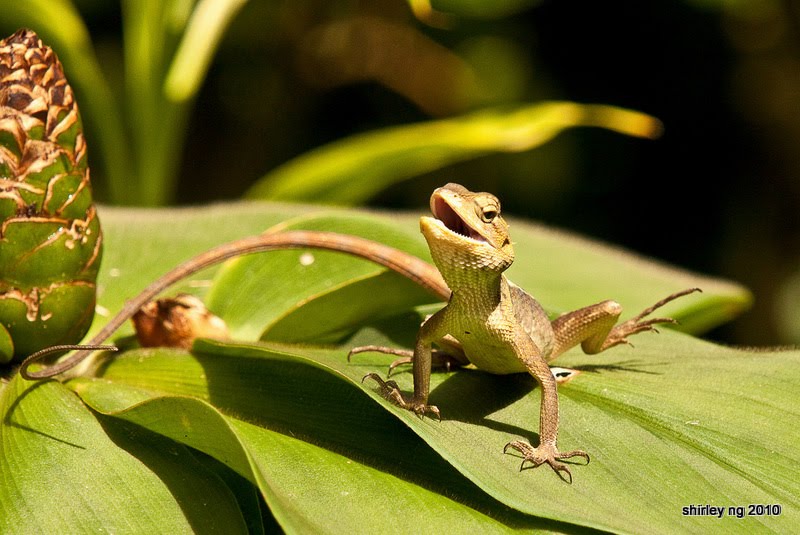
Here Is Something Green and No It Is Not A Chameleon

You won’t see this stunning green native lizard often as it has been steadily edged out of the ecosystem by the Changeable Lizard, an introduce species.
The plight of the Green Crested Lizard is but one of the many examples of how introduced species can push native species to extinction.
These days, our local bright green lizard can only be seen in nature reserves. Even here, the chances of seeing a Changeable Lizard are higher.
And folks these lizards are not chameleons. I once received a frantic SMS from a friend asking me where she could find chameleons in Singapore for her daughter to view She vaguely recalled seeing green lizards in her garden when young and assumed that they were chameleons because they changed color. Even though both the Green Crested and Changeable Lizards do change color but they aren’t chameleons.
Chameleons are found in Africa, Madagascar, Spain and Portugal, across South Asia, to Sri Lanka but not in South East Asia. They are slow moving lizards while the two South East Asian species are nimble and fast.

Friday, April 09, 2010

Sungei Buloh, the Heritage Park

I spent two mornings at Sungei Buloh during the Easter break testing the Canon EF 300 f/2.8 IS L Lens with a 2x teleconverter. I chose Buloh as it had the best ecological diversity and I knew I could find a couple of my pals within the wetland reserve.
On the first day, I didn’t get past the main bridge, set-up the camera and waited for the wildlife to come to me. Not long after I spotted a lone Smooth Otter that quietly swam by under the bridge. He made his way out towards the sea.
Not long after, the resident Estuarine Crocodile made its presence know. I must have shot a lot of frames of the crocodile in various positions as it was very active that morning.
While waiting for the crocodile to change positions, I had a pair of Painted Storks to photograph. It was also the first time I have seen Painted Storks at Sungei Buloh.
The Painted Stork is a large wading bird that is found in the wetlands of the plains of South Asia extending into Southeast Asia. They have distinctive pink feathers giving them their name. They flew in to forage in Sungei Buloh during low tide. The pair immersed their half opened beaks in the shallow water to scare up their prey of small fish that are sensed by touch. As they waded along they also stirred the water with their feet to flush out hiding fish.
There is no definitive answer as to whether the Painted Storks and the Milky Storks are wild or captive birds from the nearby bird park. Many believe that they belong to the zoo or the bird park. However, I have been told that these are wild birds that roost within the zoo and the bird park.
The next morning, I rendezvoused with a family of four Smooth Otters. For me these encounters are magical moments and I never tire from watching these highly sociable mammals interact with each other.
Also seen were the Oriental Magpie Robin another species that is also coming back from near extinction by the hands of man. Also spotted were a couple of over stayers that do not want to depart from our balmy food rich wetland area.
Though we have higher chances of seeing Smooth Otters and the Estuarine Crocodile, both are still listed under 'Critically Endangered' in the Red List of threatened animals of Singapore. However, it is heartening to see that conservation efforts over the 16 years have brought the Sungei Buloh Wetlands back. To see the return of apex predators such as the Smooth Otters and the Estuarine Crocodiles must be especially heartwarming moments to those who are involved in the conservation of the area.

Tuesday, April 06, 2010

The Wild Gems Within The Mandai Orchid Gardens

The land lease for the Mandai Orchid Garden will expire in January next year. Not only will the oldest orchid will close, the land will be part of a site to be developed as a nature-themed attraction in Mandai. It will be a sad day if we lost this garden not only for the variety of orchids it contains. The garden is also home to some rare birds such as the Little Spiderhunter. These birds are only seen in secondary forests in Singapore. Did you know that they have become locally extinct within the Singapore Botanic Gardens?
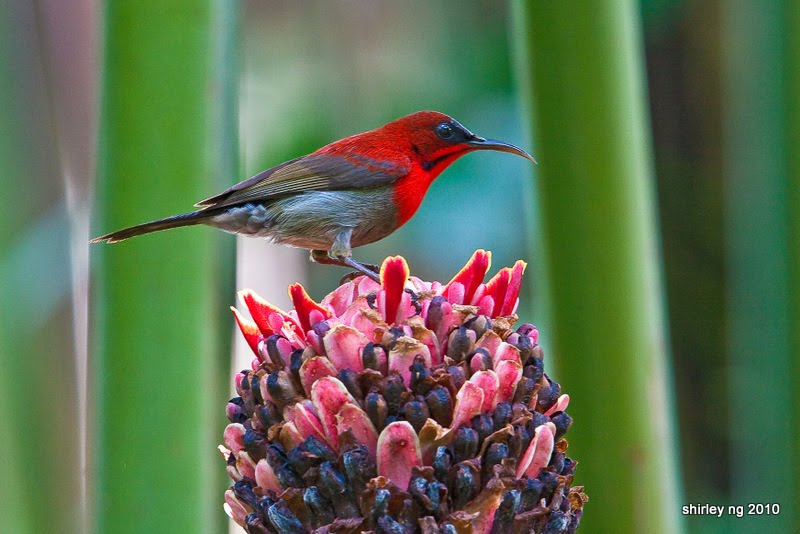
Besides, the Little Spiderhunter, there are also the ever delightful sunbirds, such as the Crimson, Olive-backed, Plain-throated and Brown-throated.
Hence, many of us have been making trips to the garden to photograph these birds as they may be soon hard to find.
The best place to go to enjoy these birds is the Water Garden as they zip around the Torch Ginger blooms. Not only are there birds but there are also cute little lizards that may decide to entertain you while you wait for the fast moving birds to settle on the blooms.
When I last visited on April 1, a Brown-throated Sunbird was seen in an altercation with self in the car park. This bird did not like its own image in the side-view mirror of a parked van and was furiously fighting with itself.
If you do get a chance drop by the Mandai Orchid Gardens before their lease runs out.

Sunday, April 04, 2010

Rainy Day Fixes

What can you do when the weather keeps you indoors? Sleep, read, watch DVDs or surf the web. The list is endless. Me, I like to potter around the kitchen creating yummy things, which are not necessarily good for the waistline.
Wondered into town some three weeks ago to correct my blurring reading vision, meant a visit to my favorite baking supply shop – Sun Lik. Stocked up on Valhorna chocolate and other sundry baking goods and got introduced to a nifty muffin premix. I don’t normally go for premixes but this one bucks the trend. The muffins came out moist and fluffy but being me I chose to be creative even with the premix. Over a number of rainy days, I have pulled out other ingredients from the fridge and pantry to add them into the premix. Strawberries that were hiding in the fridge got thrown into a batch. Dried pineapples went into the next batch.  And Ghirardelli Chocolate chips added oomph to a batch of chocolate muffins for my afternoon tea party of chocolate indulgence.
A friend brought along a bottle of Jeju Tangerine jam from Korea that turned out devine as a topping for the chocolate muffins.

Thursday, April 01, 2010

Finding a 2m Long Boiga

My luck for spotting snakes is returning. This morning a group of mynahs hovering over a drain along Island Country Club Road seemed unusual. A peek into the drain revealed a long thin snake of over 2 meters.
It was moving rather sluggishly. I dumped my backpack,  pulled out my camera, and started to photograph the snake Rat Snake was my initial thought but it didn’t seem right. My next guess was a Cat Snake as it was thin, long bodied snakes with large heads and large eyes.
Upon closer look at the snake, I found that it had two large ticks at the base of it skull.
With rains and then the subsequent hot weather, conditions were also ideal for tick infestation. This wasn’t good as ticks can be harmful to reptiles. Previously, a rescued Spiny Hill Tortoise plucked from a drain also had ticks.
After taking my photos I hoofed it to the NParks ranger station to confirm the identity of the cat snake.
Boiga is a group of mildly venomous, rear-fanged, snakes typically known as cat snakes. They are primarily found throughout Southeast Asia, India and Australia, and there are 33 recognized species in the genus. The snake that was in the drain was a Dog-toothed Cat Snake
I then went back with my friends from NParks as only they could retrieve the snake and relocate it away from the busy road. Unfortunately, the snake expired while being transported to safety. We do not know what caused its death. There were no external injuries on its body, other then it was sluggish and weak it okay. The snake was 2.25 m long from nose to tail.