Showing posts with label biodiversity - invertebrates. Show all posts

Thursday, August 04, 2016

Blogging again....

Some of my friends have been urging me to start writing again. Since I wasn't teaching and still nursing a cough, I thought I'd refresh my blog and also write an update. 
Wow! it has been a year since I last posted. During that time frame many things happened: -

The Famous Five is now the Bishan 10
The pair had another litter of five pups in the Kallang Basin area at the beginning of 2016. Since then they've been in the media darlings. BBC News called them "Singapore's celebrity urban otter family". NatGeo Wild, referred to them as the river-siders in their documentary - Otter Town that was recently released in the US. The family is also in the running to be our 51st icon to represent our nationhood. They also delighted many of the delegates from the 13th International Otter Congress 2016, which was held here in Singapore. The International Otter Congress, held once every few years, gathers members of the International Union for Conservation of Nature (IUCN) Otter Specialist Group (OSG) to discuss conservation statuses, future strategies and threat mitigation for the 13 otter species.


Monday, September 05, 2011

Pit Vipers of Singapore

It's been quite a while since there was a post on this blog on snakes. This is because they have become harder to find and encounters during my morning walks in the Central Nature Reserve (CNR) have dropped to zero sightings. A quick check with other regulars also confirmed that snakes have all but gone from the usual places we use to encounter them.

Tuesday, May 24, 2011

Lantern bug

Lantern Bugs are the Pinocchios of the insect kingdom. They are actually  planthoppers that have long beaks, called rostrum, which they use to suck the juice out flowers and fruits. The lantern bug can grow from 1.5 to 3 inches long from head to thorax and has a wingspan of about 2 to 2.5 inches wide, depending on the species.

Monday, November 22, 2010

A damselfly that is the size of a pin head

Was out chasing birds when a chance encounter with this unknown damselfly sent me scurrying to the car to grab my other camera with my trusted macro lens.
While squatting by the edge of a small drain, I could see tiny little white dots  floating by. Upon a closer look, I realized that the dots were tiny damselflies. Wohoo!!! I have found the mother load of Pinhead Midgets. They are suppose to be common but they are so small at 17mm, many of us do not even know that they existed. I thought there were three species, till research told me that they were all the same species.
This pretty ghostly white Pinhead Midget is a mature male.
The female is a gorgeous red and harder to spot.
The immature adult looks like a shrunk down larger damselfly.
If you do happen to be in a park where there's a clean water around squat down and look. You may spot these damselflies, they usually perch on grass.

Thursday, August 12, 2010

Who would have thought….

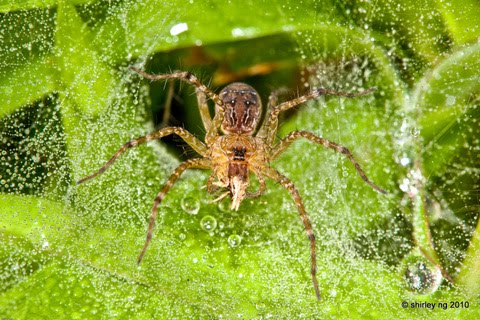
Ever looked at an incy wincy spider through a macro lens or a magnifying glass? Who would have thought that these eight legged air-breathing arthropods would be so interesting? I got seriously bitten by the spider bug recently. May be because I’m a lot more confident with my macro skills spider details are beginning to pop out.
These are some of the interesting spiders that you can find. Like with all of nature’s creatures, they serve a purpose. So do not think of them as gross or useless nuisance, they help keep the population of other insects at check.
I do not know all the names of the spiders but the first spider is a Lawn Wolf Spider and you will see their webs in fields of grass. They are the glistening webs that are often covered in dew in the morning.

Sunday, December 20, 2009

Where Are Our Butterflies?

I embarked on my digital photography adventure by shooting butterflies that were around the area I live. In the past three years, I have noticed the disappearance of many butterfly species so much so I rarely photograph them these days. It is alarming if one notices the cut back of the secondary forest. Some one likened it to slash and burn as the intensity of the clearing usually leaves the large area bare.
The lovely butterflies I have here are all bred in a butterfly park. Though they are lovely to watch, I wish they were all free and gracing their natural habitat.
These should be common butterflies here but they aren't common anymore. These Great Mormon (male and female) were among the swallowtails that are beautiful and showy butterflies full of grace as the fleet around. The Lime Butterfly another from the swallowtail family that I seldom see in my garden.The Malay Lacewing, also not seen in over a year. I went all the way to Auckland to photograph these lovely butterflies. Will butterfly parks be the only place to see butterflies in the future?

Tuesday, November 10, 2009

Butterflies@SBWR

Been heading to Sungei Buloh to otter spot and crocodile hunt but I did also spot some butterflies that were worthy of mention. While aimlessly wondering around the fresh water pond area on route 3, decided to stop to see if the Scaly Breasted Munias would come back to feed on the grass seeds. Instead of the Munias, a Blue Pansy came into sight and it became my subject. Since my macro lens was at home, the Bigma had to double up as a macro lens.
Another day, a small Lascar presented itself to me as you can tell I can't tell the Lascars apart. Thanks to Commander, I now know that the Lascar is the Perak Lascar.The butterfly that got me excited was this Lycaeninae that I spotted last Saturday. It's one which I've never seen before. It was a mid-sized Lycaeninae what caught my attention was the brilliant dark blue flashes as the butterfly flew from leaf to leaf. Again wrong lens and no flash so improvised to get a record shot. I think it is a Centaur Oak Blue. May be I haven't been paying that much attention to butterflies but it is nice to see some interesting ones around Buloh.I've not encountered many butterflies this year along my usual routes. May be their host plants have been weeded out but I am definitely seeing very few butterflies compared to the previous years.

Saturday, September 05, 2009

Puddling

Spotted this butterfly sitting on the gravel while heading home. As usual, couldn't resist pulling out the camera to document the butterfly's activity.
The butterfly is a male Cruiser, the species is pretty common in the nature reserves. This male butterfly is puddling. Though butterflies get most of their nutrition from nectar. Nectar lacks some important nutrients that butterflies need for reproduction.
In order to extract minerals, butterflies puddles, to take in salts and minerals from soil or animal droppings. This behavior is mostly seen in male butterflies as they incorporate these extra minerals into their sperm.
When butterflies mate, the nutrients are transferred to the female through the sperm. These extra minerals will help to improve the viability of the female's eggs, increasing the pair's chances of passing on their genes to another generation.
For the male Cruiser I photographed, it was puddling on a dollop of monkey poo.

Wednesday, July 01, 2009

The Crab With Blue Blood

The NParks staff giving the talk during the Prawn Watch had a Horseshoe crab in a plastic tray along with some prawns and marine snails. These creatures were collected the night before to allow a little show and tell before the prawn harvesting demonstration got underway.The horseshoe crab is a 'living fossil', and the blood of horseshoe crab turns dark blue when exposed to the oxygen in the air when it is cut or stabbed. As the crab is relatively rare, this crab was later released.

Sunday, January 11, 2009

No Fish, Prawn Also Can

A Hokkien saying but oh so apt. Where have all the creatures of the forest gone? Have they all gone on vacation? Cause if they are around I don't see them.
During major droughts like this, I will settle for anything I can find. Like this dragonfly with bumble bee colors. Don't gasp! I know it has a proper scientific name but they are all such mouthfuls. I even took an extra 30 min detour just to see if the route I've not walked in sometime will yield anything. I found a small black damselfly but because of its size and where it was sitting I couldn't get a good shot. My fault since I dumped the external flash in favor of a lighter set-up. It also means that I'm going to have to make a trip out again to find this damselfly and get a better photo.As I was approaching the end of my detour, this little fella showed himself.Okay, the little prawns that popped out weren't bad at all.

Wednesday, December 31, 2008

Butterfly Farms In Cameron Highlands

I squeezed in five hours at the two butterfly farms. The first hour was a recce trip in the evening before the farm closed. Then I got dropped off at 8.30 am the next day for four hours of unadulterated exploration of both farms. At four ringgit per entry, I wasn't complaining as it was cheap compared to the butterfly attraction at Sentosa.
The bonus was I got to meet a number of creatures that I've not had a chance to see in the wild yet. Like the Horned Frog, which is a master of disguise.

The walking leaf a ball of Pope's Pit-vipers And of course, the butterflies but they were a sorry bunch as many were in poor condition or a their last stage of life. I had to work hard to find good specimens for the camera which weren't too damaged from banging around in the enclosure. This is the Pallid Faun, which was stunning and healthy. Rajah Brooke the most plentiful as people want to see large beautiful butterflies but they were also the sorriest bunch as many were listless and dying.It was the same with the Common Birdwing. I only found no more than five that were active and feeding. Five hours gave me lots of photographs and I had to be very selective. Please go to Flickr to see more photos. Enjoy!

Saturday, November 15, 2008

The White Dragontail

Here's another butterfly that I've not encountered in Singapore. It flies as fast as the Darters and it took sometime for it to settle down in the damp sand near the hot spring to puddle. The White Dragontail, is a species of swallowtail native to parts of South Asia and Southeast Asia. If only it opened its wings.

Thursday, November 13, 2008

A Butterfly Called Paris Peacock

This was a butterfly that I encountered in Laos at a hot spring. It's an extremely fast flyer and I had to be kind to my guide while I waited it out in the heat to try to photograph this butterfly. The Paris Peacock is a species of swallowtail butterfly found in South Asia.I'm glad I did as it was a very beautiful butterfly.

Wednesday, October 01, 2008

Butterflies at Khoung Si Falls

I made this trek on my own as my guide was doing the Merlion (throwing up) and too green to climb. It was an easy trek and I was able to navigate my way to the falls. The huge bonus of going alone was I managed to take time to look for butterflies and I was very pleased with what I found.
It started with the Common Imperial sitting on the yellow cover of trash container. I know it is from the Lycaenidae family, which is the second-largest family of butterflies.
Then there is this butterfly with under wing pattern that resembles batik. I'm told it's not a Lascar but one of the Jesters from the genus Symbrenthia.Last but not the least, the tiny Common Pierrot which is the smallest of the three butterflies I found.It was a fantastic afternoon as I found and photographed three new butterflies.

Sunday, February 24, 2008

Hair Style Of A Caterpillar

The weather has been extremely dry and everything is turning brown in the heat. As a result, I am trying to keep hungry bugs away from my healthy plants. Not only are mealy bugs running amok but the moths too. I keep getting these funky looking caterpillars from an unidentified Tussok moth that love to chomp up my night blooming water lily.
This is the bloom from my plant and I would like to keep the plant healthy as it took me over a year to coax this plant into flowering so I can ill afford to let the caterpillars destroy the plant.This plant is flowering freely and I don't want it to go dormant again. It's flowers also attract little bees and they make good photo subjects too when I have nothing to shoot or when I would like to practice shooting insects hovering.
Despite being a plant terror, I thought it made an excellent subject with its fancy hair do. Nature does have a way in making her creatures look funky and interesting. If you don't look too hard and you can almost see the head of the lion with bushy brows from the lion dance troupe in the caterpillar.

Friday, January 18, 2008

Insect Scrapbook

I obviously could not leave my camera in the dry box for long before itching to take it out and shoot mother nature's amazing creatures in their habitat. These are some of the interesting tiny insects that I chanced upon while being chased by mossies all through my walk.
I shot with a macro lens and a macro filter, to get more details that the naked does not see. These images have also been cropped and enlarged as my subjects are all no more than 5mm small.
Lastly, I do not know the names nor the species of the insects I found. I will generalise and even give you quirky names just for the heck of it.
This here is a brown eyed hairy fly on an equally hairy leaf.
A little insect-sutra going on here.Next is a scorpion ant, it only 3mm big but beware. It gives a nasty sting that hurts like hell and then itches forever.And the strangest insect that I found was this prehistoric looking grasshopper on a piece of rotting wood. It was moving around like a tiny tank to my amazement.

Saturday, January 12, 2008

I Spy Life On Rotting Wood

I squatted down near a decaying log that was covered in wild mushroom. As I peered down on the rotting wood, the wood suddenly began to show off its inhabitants. These are some of the amazing creatures I found on just this piece of rotting wood.
A fly with psychedelic eyes.Beetle Bug here and his friends feeding on the mushrooms.A funky tiny grasshopper.And this little fella, a crab spider, seemed to be on magic mushrooms as it ran around waving its arms at me. It is called a called crab spider because of it first two pairs of legs, which are held out to the side giving it a crab-like appearance. Crab spiders do not build webs to trap prey, but are active hunters much like the jumping spiders.