Showing posts with label biodiversity - avian. Show all posts

Friday, April 21, 2017

Blue-crowned hanging parrots

Often we hear the high pitched honking calls of the blue-crowned hanging parrots as they zip around the Little Red Dot. They are also the only parrot that you will hear along the busy roads of our business district. This is because they favor the yellow flame trees that are planted along the roads, which provide them with food and ideal nesting holes. Their diminutive statue and green color make difficult to spot among the leaves. They are also not as noisy as the parakeets and can move quietly among the foliage. It takes a lot of patience and ignoring stares of people around you as you peer closely at a tree to spot them.
Can you spot the parrot?
Although they are nectar and fruit feeders, they need protein too to survive. In the wild, nature provides them with larvae. In the photo below you'll see a parrot drinking nectar. Look at the leaves of the tree, they've been punched full of round holes. These holes are the result of an infestation of bagworm moth larvae.

I was lucky to have seen photos from a friend who had photographed these parrots doing something unusual, they were harvesting larvae to eat. Spent some time to document this behavior plus I couldn't resist getting better shots of the handsome male blue-crowned hanging parrot.
Plucking larvae to eat
Male blue-crowned hanging parrot

Monday, June 22, 2015

The story of the little town parrots

I was in Little India having some fun locating street art in the back alleys. While photographing people who collect cardboard boxes for recycling, I heard a familiar tweeter of my little nemesis - the blue-crowned hanging parrot. It sounded close, like directly above me.

Saturday, May 02, 2015

Against all odds

Spotted a pair of grey-rumped treeswifts in the midst of building a nest cup on March 01. The female had almost finished her work.
Forgot about the pair as I focused my attention on watching and learning about the pair of smooth-coated otters that are in neighborhood. On April 21, dropped by the location to check on the pair to find this little fella sitting in the nest cup. That afternoon, we had a huge storm but I didn't go on site to check on the chick.
When I did on April 23, the nest was empty and the parents were flying around but there wasn't any calls from the chick. I felt sorry for the parents as they has lost a chick that was so close to fledging. The next day, they were still hanging around and showed no signs of leaving the area. I thought to myself there may be a glimmer of hope.
On April 27, while passing the area I heard the excited calls and then saw one of the parent shadowing its fledgling in flight. It was probably the best Monday I had knowing that the little fella survived the storm and fledged.
Daddy was trying to coax it to fly but the fledgeling wanted to be fed instead. He flew off leaving the young one to stretch its wings, and wonder when one of its parents will relent and feed it.

Tuesday, January 13, 2015

Unusual behavior of long-tailed parakeets

I first observed the unusual behavior of long-tailed parakeets feeding on the old roof tiles in my neighborhood last year after a heavy downpour.
On the evening of 8 January 2015, I again observed the same behavior with a a flock of long-tailed parakeets that made a stop over in the evening before they head to their roosting site. They were up in the rain trees as usual but a couple of birds started to descend onto a neighbor's roof then more started to follow. Soon there were over fifty birds on the roof peeling off material from the roof tiles to eat.

Sunday, November 30, 2014

Rainbow lorikeets

My first introduction to the gregarious rainbow lorikeet was at the bird park's lory loft. Then there was the group of four birds trying to establish nest holes at Malcom Park in 2011 to the pair that  flew around my neighborhood.
Last week I heard the calls of many parrots in the trees along Ang Mo Kio Ave 1 but didn't stop to check out what species. I assumed that they were either long-tailed, red-breasted or rose-ringed parakeets since they are common in the area. It wasn't till Wednesday did I realize that they were rainbow lories (green-naped lorikeets) when I caught sight of a pair flying over me.
Pulling out the bins from the car and painstakingly peering through them at the birds feeding  on the flowering trees yielded javan mynas, orioles and finally the noisy rainbow lories (plenty of them).

Sunday, November 23, 2014

A lazy Sunday morning at Haji Lane

I kinda like a quiet and lazy stroll around the Kampong Glam area on an early Sunday morning. There's hardly anyone around and the area is peaceful. These two kartek ayams and their girlfriend greeted me in the car park. They belong to someone who lives in the neighborhood. Ended getting down on the ground to photograph them with a wide angle lens since I was too lazy to pull out my other lens from the boot.
Sargent major here was crowing his lungs out.

Thursday, November 13, 2014

Great-billed herons courtship dance

Lucky me caught the courtship dance of a pair of great-billed herons at Sungei Buloh last Sunday. 
There were initially three herons in breeding plumage breeding (sliver streaked feathers on the lower neck, back and crest) but it was difficult to tell which of the three was the female since these herons have no plumage dimorphism.
The first heron started a display and the other fly in from across the rock island and they began a courtship dance, which was very interesting to watch. Another thing that I noticed was the growling sounds that the pair were making. Although we were very far from the pair we could hear them vocalizing as they danced.


Monday, November 04, 2013

Flying with an eagle

incoming eagle
Morning walks these days are full of distractions on the ground and in the air. There are times when a pair of white-bellied sea eagles will circle above or fly low in search of food. With the blessing of clear blue sky photographing a white-bellied sea eagle is just the most enjoyable arm exercise by the time I'm through with the session I'm sweaty and my arms are aching.

Wednesday, September 11, 2013

Fall 2013 migration

Fall migration has began in earnest. Five young Asian dowitchers arrived at Sungei Buloh Wetland Reserve on Monday together with a grey-tailed tattler. By yesterday another dowitcher joined the group along with a black-tailed godwit.
The Asian dowitcher is a rare mid-sized wader that is near threatened. It breeds in inland northern Asia during the spring/summer months and winters in Southeast Asia down to Australia. Unfortunately for us the Asian dowitcher is a passage migrant and it only stops for a day or two to rest and feed before moving on. After missing the bird during the previous seasons I'm happy to be rewarded with six birds. The last record of such a high count was during the 1980 migration.
5 Asian dowitchers actively feeding, the 6th was sleeping

Friday, August 23, 2013

The tale of three pairs of grey-rumped treeswits

Lucky me to have chanced upon the nesting sites of three pairs of grey-rumped treeswifts. The first pair nested at the beginning of May but crows destroyed the nest (see earlier post).
The second pair at a different location started nest building in May and their chick hatched at the beginning of June, and it lived through the worse smog in Singapore's history. This chick fledged end-of-June.
Second female incubating a single egg in the nest cup

Thursday, July 11, 2013

Rails by the river bank

Some months back I spotted a lone slaty-breasted rail skulking around. This was the first sign that rails were coming back to the area. Not long after the initial sighting, there were more sightings along the Kallang River plain. 

Sunday, July 07, 2013

Failed nesting of grey-rumped treeswifts

I become quite accustomed to hearing the calls of grey-rumped treeswifts as I started to try to photograph these birds in flight.

Wednesday, July 03, 2013

The adaptable kingfisher

The collared kingfisher is one of the most common kingfishers in Singapore. Previously, this kingfisher's main habitat was mangrove and coastal areas but it has spread in land into almost all our parks. You can tell the presence of these birds by their loud calls. The Monetary Authority of Singapore between 1976 and 1984t featured the collared kingfisher on the S$10 note in the "Bird Series" currency collection.

Thursday, June 20, 2013

Wild chickens

It is said that red jungle fowls are rare in Singapore, and are listed as 'Endangered' in the Red List of threatened animals of Singapore.Lucky me, these fowls are often sighted in the area where I live since 2010.
Taken in 2010.

Monday, June 17, 2013

The rarest parrot in Singapore

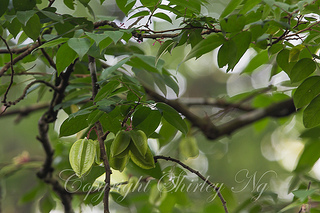
There were fruiting star fruit trees around the area close to home, and this attracted a pair of very rare parrots. The blue-rumped parrots use to frequent trees just at the car park till contractors removed their roosting tree some year ago. Since then no one has seen them in the area till now.

Monday, May 27, 2013

The other kings of the sky - swallows & swifts

Often we think of birds of prey as kings of the sky, but swallows and swifts too own the skys. They hawk insects on the fly, and they seem to effortlessly move around the open air space. It's hard to catch them at rest as often they perch high up in trees. Learning to identify these winged wonders is even harder as to the uninitiated they all look similar.
Recently, while on my morning walk, I stopped to glance skywards at the swallows and swifts zipping around. As I studied the birds, I realized that they were of different species. The largest is  the grey-rumped treeswift. I went back equipped with lens and ready to take pot shots of the swallows and swifts as they flew by.

Monday, May 20, 2013

Population of two


Little Grebes were first sighted here in 1992, in a pond near the old Punggol pig farms. By 1994, they were pretty well established till their pond habitats were filled as the area was re-purposed by the government. The population was said to have dwindled over the years.
The old Singapore Quarry site was one of the known places where a small population of little grebes existed but in recent years, they have all disappeared. The other known locations are Lor Halus at the old refuse dump site, and the new wetlands. There another small population on Punggol Barat island near the Seletar airport.
The only accessible site is at Lor Halus Wetland where a pair of little grebe hold court in a shallow fresh water pond. May be due to our tropical climate, our little grebes do not lose their breeding plumage and they seem to breed all year. 
Little grebe nest

Friday, May 03, 2013

Spot-billed pelicans of Asia

Missed these pelicans at Laem Pak Bia in Oct 2012 and was glad to finally get to see them in Sri Lanka.  
Spot-billed pelicans or grey pelicans are found in Asia. As their common name suggests, these pelicans possess a spotted bill; the throat pouch is also spotted in appearance. 
lone individual in a lake

Wednesday, April 17, 2013

Telling these two apart

I have problems differentiating between the mangrove pitta, the only local pitta left in Singapore, and the blue-winged pitta, a migrant.
Mangrove pitta (left) Blue-winged pitta (right)
I did some research and thought it would be nice to share it with everyone.  Both species are placed side-by-side for easier comparison. Three distinguishing areas to look for: -
  1. Mangrove pitta has less blue on the wing
  2. Mangrove has a longer beak
  3. Mangrove's head patch extends further back and is larger
Personally, the head patch is probably the easiest way to tell them apart in the field.