Showing posts with label biodiversity - reptiles. Show all posts

Thursday, January 16, 2014

Say hello to the brown anole

A morning visit to Gardens by the Bay for birds turned into a reptile photo session instead. On the bakau support poles propping the transplanted trees in by the car park were pencil long brown lizards sunning themselves.

Thursday, April 11, 2013

Tokay! Tokay!

Photographed in Kaeng Krachan (แก่งกระจาน)
The tokay gecko is one of the largest geckos found in Asia. They range from northeast India to the Indo-Australian Archipelago. Guess what? They are found in Singapore too but you will have to be very lucky to spot one as these lizards are nocturnal.

Saturday, May 05, 2012

Even the king needs a drink

Dry season brings all kinds of wildlife to meager watering holes. We merely had to sit patiently in hides to wait for animals to drop in for a drink.
Much to my delight we had a sizeable King Cobra drop in for a drink.It was pretty chunky but not very long.

Friday, April 27, 2012

Common forest lizards in Thailand but....

They may be common but they are interesting all the same to the uninitiated like myself.
Butterfly Lizards are endemic to Southeast Asia, and they inhabit a number of habitats. There are a total of 8 species of butterfly lizards. What makes this family of lizards unique is 4 out of the 8 reproduce through cloning (single sex reproduction). The Common Butterfly Lizard however breeds by normal sexual reproduction.
Common Butterfly Lizard

Monday, March 19, 2012

Bonuses

Pied Fantail
In addition to the birds and mammals we expected at Uncle Sin's and Mr Yao's ponds. We had a couple of bonuses, which weren't on our target list. These species can be found in Singapore but not in the open like we've seen them at the watering holes.

Saturday, February 18, 2012

Gorgeously green

I was at the zoo last Saturday morning and as is my usual habit I will go pay Elvis, the King Cobra, a visit. This time I found him in a state of stupor with his eye caps almost opaque. Elvis was getting ready to molt. I did my usual round to see what each individual reptile was up to. There were several new snakes - a female Wagler's Pit Viper, a new Mangrove Pit Viper and two Oriental Whip Snakes. It was also my lucky day to find the Green Tree Python facing the glass panel and not tucked away in a corner. It had also just gotten a bath and was glistening.
Green Tree Python

Monday, December 12, 2011

Flying snakes

Exceptional luck presented me with two flying snakes, which almost ended up with me missing the Ferruginous Flycatcher (my original target). Both were spotted sunning themselves one on a sampling and the other on the boardwalk.


Wednesday, December 07, 2011

Finally a Common House Snake

I didn't think that there were Common House Snakes in my area but then again I never tried looking for this species. My helper texted me from outside my gate saying there was a snake being harassed by one of the neighborhood stray cats.
When I went out with a torch light to check, I found a small snake no more than 10cm long valiantly defending itself against the cat. It was leaping off the ground trying to bite the cat. Once I spotted the whitish collar around its neck, I knew it was a Common House Snake.Sent my helper into the house to get a small container and net so that I could safely remove the snake from harms way.

Thursday, November 24, 2011

I love Salties

Did you know that the largest crocodilian on Earth, saltwater crocodile has made a come back in Singapore? Even though we spot them quite regularly at Sungei Buloh, saltwater crocodiles are considered critically endangered in Singapore. Historically, saltwater crocodiles were found throughout South-east Asia. However, wild population of saltwater crocodiles have not been seen in their natural habitats for decades. In fact, they are considered extinct in Thailand, Laos, Vietnam, and possibly Cambodia. Conservation efforts have seen wild populations come back. The population of saltwater crocodiles in Borneo has increased dramatically in the past decade that reptile is no longer on the endangered list. Yay! because I love great come back stories.
A bunch of us were at Sungei Buloh Wetland Reserve on our annual winter migration waders watch. While scanning the waders, my one eye was on the look out for a salty that I know was around the area. I had a series of shots already sketched out in my head if the salty would come up in the right spot and position itself correctly. It didn't take long for the fella to haul itself out of the water to recharge in the morning sun.

Tuesday, June 28, 2011

Small Croc at SBWR

Dropped in at Sungei Buloh last Sunday morning during neap tide in the hope to catch sight of otters and to see if there were any illegal drift nets set near the river mouth of Sungei Buloh. Like this photo taken on one of my previous trips.
Instead of seeing poachers, this was what greeted me. Two huge barges with excavators on  them. Could it be there are plans to construct more floating fish pens? If that happens what will become of the otters? The fish pens stocked with captive fish will be tempting tempting for the otters. Will the fish farmers end up killing the otters?

Friday, August 27, 2010

Giant lizards

Here's something you don't often see, two large Malayan Water Monitors hanging out together. The one on the wall was so big that even the large turtle that was sunning itself got out of its way.
If you wonder why? Aren't turtles protected by their hard shell? The answer is no. Even though monitors are mostly scavengers, they still do eat live prey. I have seen a mid-sized monitor grab a hold of a Red-eared Slider over at Singapore Botanic Gardens and swallow it whole. Unfortunately, there were no photographs as there was just too much obstruction.
It is quite heartening to see such large individual around. In Asia, monitors are hunted as bush meat. In fact, some people here still do eat them but I am told they aren't very tasty. 
Like their cousins the Komodo Dragons, these lizards are very strong and can inflict bites that will take very long to heal. Their mouths harbor deadly bacteria therefore their saliva is poisonous.

Sunday, August 15, 2010

Finally, caught up with a Mangrove Snake

Thanks to a tip from a friend, I dashed down to the site and promptly located the elusive Mangrove Snake. What made this encounter special was the snake was at eye level, which made photographing it a joy for me.
The Mangrove Snake or Gold-ringed Cat Snake is one of the largest in the species. It is a venomous, and rear-fanged which means that the fangs on these snakes don't inject venom, they channel it. By day it lies motionless on overhanging branches, but at night becomes active coming to the ground and feeding on other vertebrates including rodents, small birds and their eggs, frogs, bats and sometimes other snakes.
This fella was curled up having its siesta when I came upon it. It also gave me the opportunity of a life time. I set-up my equipment and went about documenting this snake from various angles using a tripod. All the time being very slow in my movements so as not to spook the snake.
Should you encounter a snake in the wild stop, turn and walk away from the snake. Remember that you are not prey to the snake. They will not waste their precious venom on you unless you provoke them. In most instances of man vs snake, the snake loses its life.

Friday, April 30, 2010

Bako: Where Nature Is Right In Your Face

Bako is Sarawak's oldest national park, and is located at the tip of the Muara Tebas peninsula. The park was gazetted as a nature reserve in 1957, and is arguably the best place to experience wildlife. Accommodations are very basic and can be very uncomfortable due to the high humidity. However, we had the best wildlife experience right at our door steps. The chalet block that we were housed is built on swampy land with puddles of stagnant water. As you may have guessed, the area is also a heaven for mosquitoes but the wildlife around us was amazing.
We had two Wagler’s Pit Vipers as neighbors and no one battered an eye at the presences of the park’s only venomous snake. The two snakes were left unmolested (no anyone attempt to lop their heads off and mince them up). I spent two days photographing the male as he was in a better position. The juvenile female was a tad small and in a harder location.
Imagine my shock coming face to face for the first time with the largest wild pig I have ever seen. The female Bornean Bearded Pig and her young ones emerged from the bush in the evening for a drink of water. I spent the next day and a half looking out for the pigs but I never got my shot at the large female. Instead, a large male came out to drink while we were waiting for the White-bellied Woodpecker and I got my bearded pig portrait.
Just like Periyar, the Silvered Langurs came right up to where the forestry office and spent a good part of the morning foraging in the trees.
Flying Lemur
A mother and baby were also sighted near the chalet and as usual the mother flying lemur slowly maneuvered around the tree to the attention got too much.
The experience that we had, left me wanting more. I can't wait to head back again. Should you want encounters of the close kind, Bako is a great place to experience wildlife at their best.

Tuesday, April 13, 2010

Here Is Something Green and No It Is Not A Chameleon

You won’t see this stunning green native lizard often as it has been steadily edged out of the ecosystem by the Changeable Lizard, an introduce species.
The plight of the Green Crested Lizard is but one of the many examples of how introduced species can push native species to extinction.
These days, our local bright green lizard can only be seen in nature reserves. Even here, the chances of seeing a Changeable Lizard are higher.
And folks these lizards are not chameleons. I once received a frantic SMS from a friend asking me where she could find chameleons in Singapore for her daughter to view She vaguely recalled seeing green lizards in her garden when young and assumed that they were chameleons because they changed color. Even though both the Green Crested and Changeable Lizards do change color but they aren’t chameleons.
Chameleons are found in Africa, Madagascar, Spain and Portugal, across South Asia, to Sri Lanka but not in South East Asia. They are slow moving lizards while the two South East Asian species are nimble and fast.

Friday, April 09, 2010

Sungei Buloh, the Heritage Park

I spent two mornings at Sungei Buloh during the Easter break testing the Canon EF 300 f/2.8 IS L Lens with a 2x teleconverter. I chose Buloh as it had the best ecological diversity and I knew I could find a couple of my pals within the wetland reserve.
On the first day, I didn’t get past the main bridge, set-up the camera and waited for the wildlife to come to me. Not long after I spotted a lone Smooth Otter that quietly swam by under the bridge. He made his way out towards the sea.
Not long after, the resident Estuarine Crocodile made its presence know. I must have shot a lot of frames of the crocodile in various positions as it was very active that morning.
While waiting for the crocodile to change positions, I had a pair of Painted Storks to photograph. It was also the first time I have seen Painted Storks at Sungei Buloh.
The Painted Stork is a large wading bird that is found in the wetlands of the plains of South Asia extending into Southeast Asia. They have distinctive pink feathers giving them their name. They flew in to forage in Sungei Buloh during low tide. The pair immersed their half opened beaks in the shallow water to scare up their prey of small fish that are sensed by touch. As they waded along they also stirred the water with their feet to flush out hiding fish.
There is no definitive answer as to whether the Painted Storks and the Milky Storks are wild or captive birds from the nearby bird park. Many believe that they belong to the zoo or the bird park. However, I have been told that these are wild birds that roost within the zoo and the bird park.
The next morning, I rendezvoused with a family of four Smooth Otters. For me these encounters are magical moments and I never tire from watching these highly sociable mammals interact with each other.
Also seen were the Oriental Magpie Robin another species that is also coming back from near extinction by the hands of man. Also spotted were a couple of over stayers that do not want to depart from our balmy food rich wetland area.
Though we have higher chances of seeing Smooth Otters and the Estuarine Crocodile, both are still listed under 'Critically Endangered' in the Red List of threatened animals of Singapore. However, it is heartening to see that conservation efforts over the 16 years have brought the Sungei Buloh Wetlands back. To see the return of apex predators such as the Smooth Otters and the Estuarine Crocodiles must be especially heartwarming moments to those who are involved in the conservation of the area.

Tuesday, April 06, 2010

The Wild Gems Within The Mandai Orchid Gardens

The land lease for the Mandai Orchid Garden will expire in January next year. Not only will the oldest orchid will close, the land will be part of a site to be developed as a nature-themed attraction in Mandai. It will be a sad day if we lost this garden not only for the variety of orchids it contains. The garden is also home to some rare birds such as the Little Spiderhunter. These birds are only seen in secondary forests in Singapore. Did you know that they have become locally extinct within the Singapore Botanic Gardens?
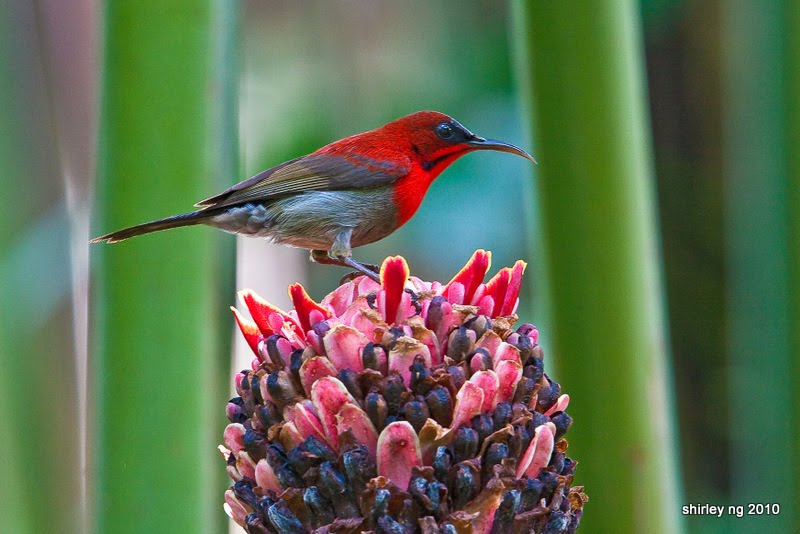
Besides, the Little Spiderhunter, there are also the ever delightful sunbirds, such as the Crimson, Olive-backed, Plain-throated and Brown-throated.
Hence, many of us have been making trips to the garden to photograph these birds as they may be soon hard to find.
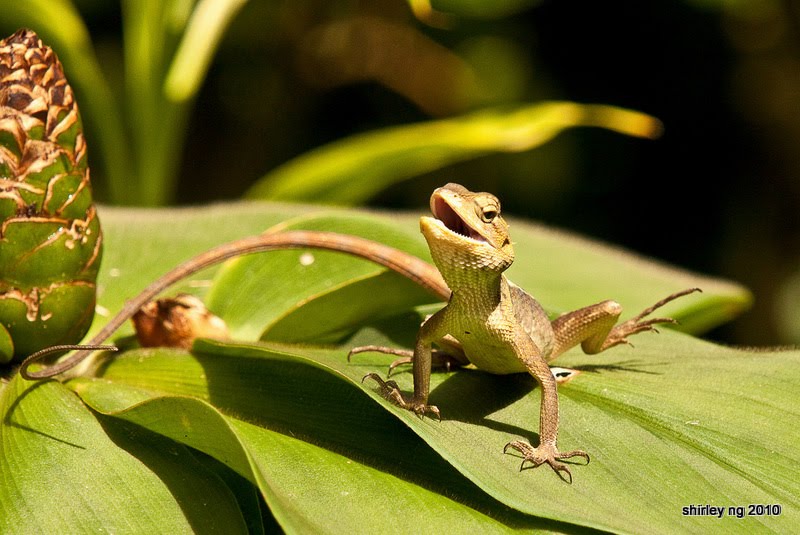
The best place to go to enjoy these birds is the Water Garden as they zip around the Torch Ginger blooms. Not only are there birds but there are also cute little lizards that may decide to entertain you while you wait for the fast moving birds to settle on the blooms.
When I last visited on April 1, a Brown-throated Sunbird was seen in an altercation with self in the car park. This bird did not like its own image in the side-view mirror of a parked van and was furiously fighting with itself.
If you do get a chance drop by the Mandai Orchid Gardens before their lease runs out.

Thursday, April 01, 2010

Finding a 2m Long Boiga

My luck for spotting snakes is returning. This morning a group of mynahs hovering over a drain along Island Country Club Road seemed unusual. A peek into the drain revealed a long thin snake of over 2 meters.
It was moving rather sluggishly. I dumped my backpack,  pulled out my camera, and started to photograph the snake Rat Snake was my initial thought but it didn’t seem right. My next guess was a Cat Snake as it was thin, long bodied snakes with large heads and large eyes.
Upon closer look at the snake, I found that it had two large ticks at the base of it skull.
With rains and then the subsequent hot weather, conditions were also ideal for tick infestation. This wasn’t good as ticks can be harmful to reptiles. Previously, a rescued Spiny Hill Tortoise plucked from a drain also had ticks.
After taking my photos I hoofed it to the NParks ranger station to confirm the identity of the cat snake.
Boiga is a group of mildly venomous, rear-fanged, snakes typically known as cat snakes. They are primarily found throughout Southeast Asia, India and Australia, and there are 33 recognized species in the genus. The snake that was in the drain was a Dog-toothed Cat Snake
I then went back with my friends from NParks as only they could retrieve the snake and relocate it away from the busy road. Unfortunately, the snake expired while being transported to safety. We do not know what caused its death. There were no external injuries on its body, other then it was sluggish and weak it okay. The snake was 2.25 m long from nose to tail.

Monday, March 29, 2010

Afternoon Showers Bring Out the Reptiles

The recent afternoon showers caught me left footed as I have been without my camera for the past several mornings during my morning walks. Friday morning's huffing and puffing came to a jolting halt when I spotted what looked like a foot-long wire with a red line down the middle. Upon closer inspection the wire turned out to be a snake that was trying to warm up on the grass verge. Initial thoughts were a Striped Kukri, however, this snake didn't change color like the Striped Kukri I encountered previously. That only means that the snake before me was the Malayan Banded Coral Snake. Upon realizing that it had been spotted the snake turned slowly and moved back into the undergrowth. Since it was in an area where many people pass every morning, made sure that it was completely out of sight before leaving the area. It was probably hunting for the tiny Brahminy Blind Snake as it feed primarily on other snakes similar to King Cobras that prey on Rat Snakes.
Went to the same location the next day, in the hopes of spotting the Malayan Banded Coral Snake again but it was not to be. At the end, the walk yielded two relatively large Clouded Monitor Lizards sunning themselves.
This is good as it means that the population of Clouded Monitors are pretty healty in the area.

Thursday, February 18, 2010

A Juvenile Wagler's Pit Viper

I'm on a roll. Finally, managed to find a juvenile Wagler's Pit Viper.This pit viper is one of my favorite species to photograph as they are just the most gorgeous snake ever.
The Wagler's Pit Viper is a medium sized viper which can grow up to over a meter. It is a pit viper because they have pits just behind the nostrils which contain special organs that can sense heat and locate warm-blooded animals. This is an important adaptation as the Wagler's Pit Viper is nocturnal and hunts at night.The adult males are green, with a black border and many greenish-yellow crossbars on its back. The juveniles change color as they grows. The young are all green with spots of white and red. The spots are sometimes arranged in pale crossbars. Like the one I found.The other thing that is unique about pit vipers is the prehensile tail.For those who fear snakes, please note that the Wagler's Pit Viper may be classifed as venomous but it rarely bites. Should you encounter one leave it alone. Just walk away, do not harm it.

Saturday, February 13, 2010

The Resident Common Bronzeback's Feast

Still busy photographing the pair of Kings. They aren't finished with their parenting duties yet. When the helper shouts from the backyard below, "MDM, COME SNAKE!!!"
What snake could it be? As I raced to grab the macro lens just in case I needed it. Upon arriving at the backyard, I initially couldn't see the snake. The helper said black snake but I didn't see a black snake. It was only till she point it out that I saw it and realized that the snake was the resident Common Bronzeback that we spotted last year. It indeed preyed on the Four-lined Tree Frogs as it had one in its mouth. The frog was frantic and yelping away trying to get out of the snake strong grip.As this was a natural occurrence in the wild, I did not intervene in the struggle between predator and prey. Instead, I silently observed the scene and documented it.
One thing that became apparent during the 30-minute struggle, the Common Bronzeback was obviously non-venomous. It had a strong grip on the frog and seemed to be strangling it with it mouth.
The snake dragged the frog behind my potted plants and fell with it prey through the mesh netting. Froggie thought is would try to cling onto the clothe peg and release itself from the vice like grip.Snake and frog eventually fell on to the clothe stand in my neighbor's backyard.They stayed there for another about 15 mins before the snake disappeared with the frog. It could have slithered into the drain to quietly finish off its prey.